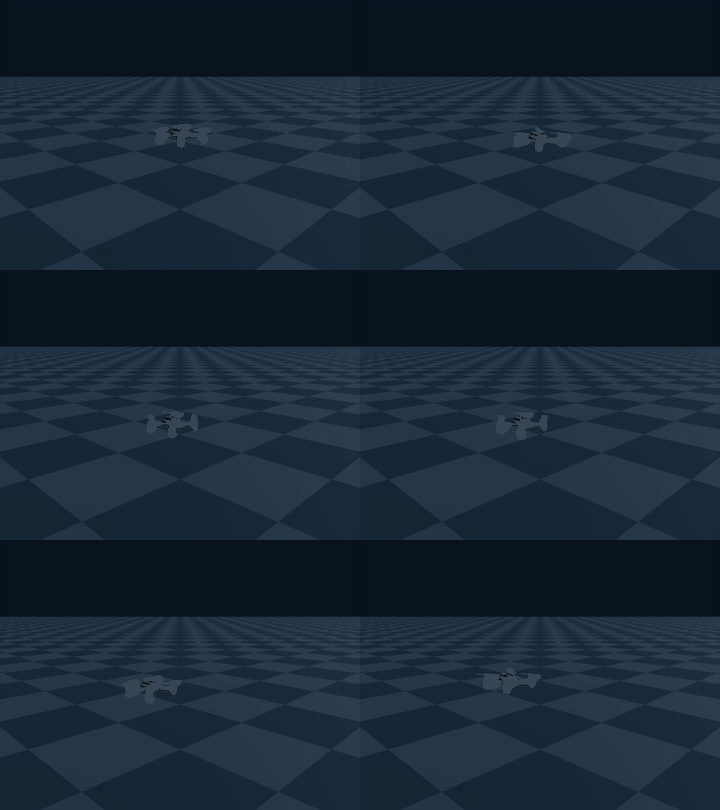
Genesis Robust Quadrotor
Robust-RL framework for drones on the Genesis simulator — 69 perturbations across 8 categories (physics, motors, sensors, wind, …), adversarial-training API (DR / RARL / RAP), Gymnasium-compatible.

PhD · Deep Reinforcement Learning
PhD (CIFRE) at ISAE-Supaero with Airbus Commercial Aircraft, developing exploration methods for deep reinforcement learning applied to critical system testing. MSc in autonomous robotics from ENSTA. Passionate about RL and its applications to robotics.
Robust-RL framework for drones on the Genesis simulator — 69 perturbations across 8 categories (physics, motors, sensors, wind, …), adversarial-training API (DR / RARL / RAP), Gymnasium-compatible.
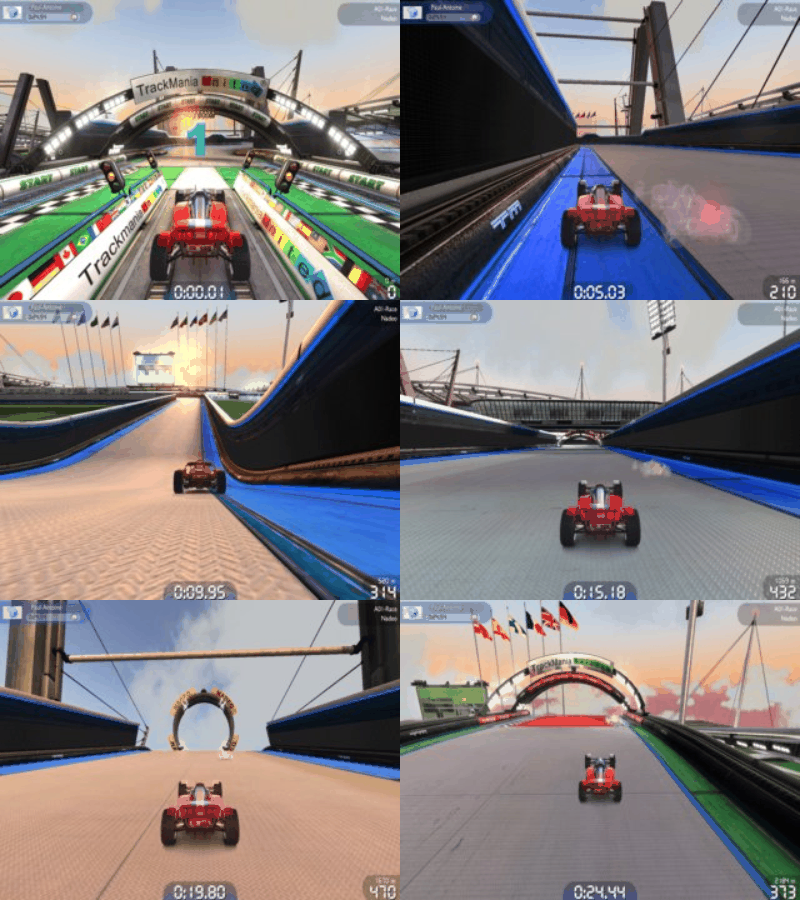
ACT behavioral cloning and offline IQL on TMNF, shared frozen DinoV2 encoder. Mac serves inference over TCP, Windows runs the game.
A quadrotor drone combat simulator where multiple autonomous agents fight each other using deep RL policies.
DDPG policy trained to dock a UAV autonomously. CNN + LSTM observations, deployed on Nvidia Jetson with ROS, validated in Gazebo simulation.
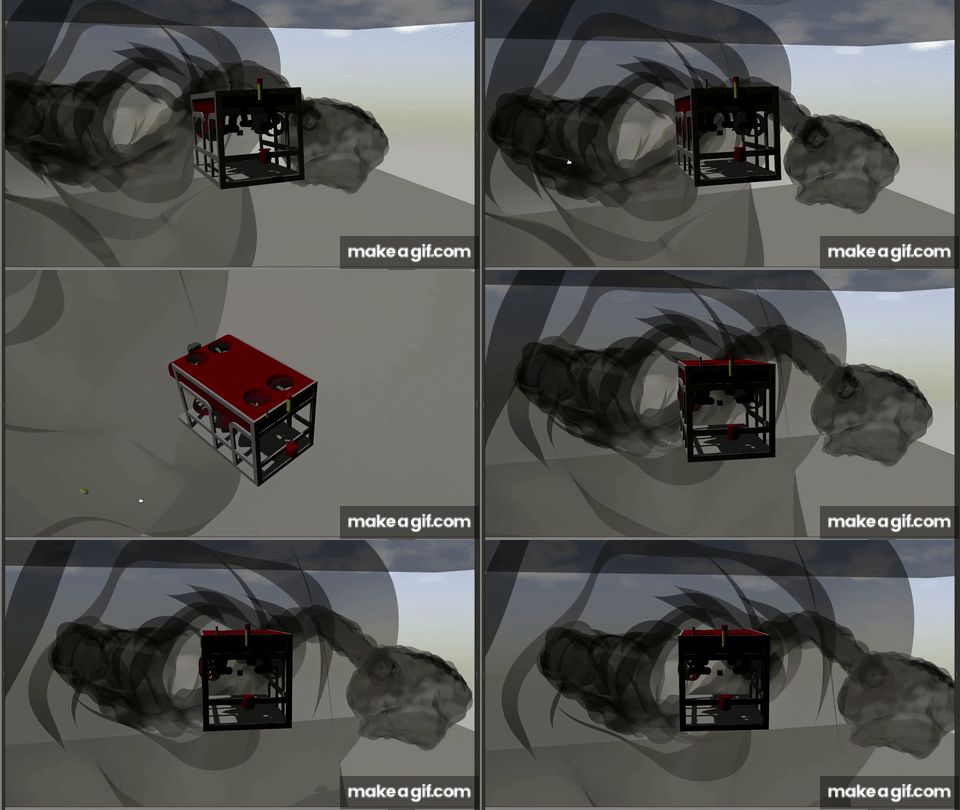
Gazebo simulation for mobile robot navigation in underwater karst terrains, with an interval-analysis framework for uncertainty quantification.
Exploring new directions beyond classical robust RL formulations for policy robustness under distribution shift and uncertainty.
Smooth manifolds, Christoffel symbols, geodesics, and the geometry of curved spaces.
Read post →A course on the fundamentals of reinforcement learning: MDPs, policy gradient, value functions, and modern deep RL methods.
View course →A rigorous treatment of diffusion processes: SDEs, score matching, and the mathematical foundations of modern generative models.
View slides →Slides from my PhD thesis defense on exploration methods for deep reinforcement learning applied to critical avionic system testing.
View slides → RAMP
RAMP
Proposes RAMP, a method encouraging agents to explore by distancing themselves from past experiences, without reward shaping or intrinsic bonuses.
 LEADS
LEADS
Introduces LEADS, which creates a diverse set of skills to enhance exploration, without rewards or intrinsic bonuses, using successor state representations.
 ISSTA
ISSTA
Uses heuristic-based exploration to identify failure scenarios in avionics systems, improving flight system reliability through RL-driven robustness evaluation.
 Curiosity-ES
Introduces Curiosity-ES, using curiosity as a fitness metric in evolutionary strategies to explore reward-sparse environments and discover diverse policies.